
Every minute spent switching between client production runs can reduce capacity and profitability. Cleaning, equipment changes, utility connections, material movement and quality checks can quickly turn a short transition into hours of downtime. Strategic facility design can shorten these periods by making flexibility part of the building itself. Modular utilities, optimized layouts, contamination-control infrastructure and flexible equipment staging can help manufacturers serve multiple clients efficiently while maintaining strict quality and compliance standards.
Why Changeover Time Matters
Multi-client manufacturing facilities must accommodate different products, processes, equipment and client requirements. Reducing changeover time and frequency improves competitiveness and efficiency, thereby creating commercial opportunities.
A transition may require operators to remove equipment, clean and sanitize production areas, change tooling, connect different utilities, move materials, complete line clearance and obtain quality approval before the next run begins. If these activities happen sequentially, productive capacity quickly disappears. Facility design can eliminate unnecessary movement and allow preparation activities to happen before the previous production run has completely finished.
Modular Utility Systems Improve Adaptability
Utilities can become a major bottleneck when a facility serves multiple clients. One production process may require compressed air and chilled water, while another needs to process gases, vacuum, steam or additional electrical capacity.
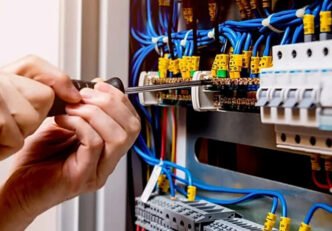
Fixed utility connections can make reconfiguring equipment slow and disruptive. Modular utility systems provide greater flexibility through strategically positioned service points, accessible distribution networks and appropriately designed connection systems.
With the right infrastructure, equipment can be disconnected and reconnected with less disruption. Modular systems can also make future facility changes easier, allowing manufacturers to accommodate new equipment or clients without extensive construction.
The key is controlled flexibility. Utility connections should be clearly identified, safely segregated and designed to meet applicable operational and compliance requirements.
Optimize Layouts for Parallel Work
A flexible facility should be designed around production and changeover workflows. Operators shouldn’t have to wait for a corridor to clear before moving equipment, search for tools stored across the building or bring materials into an active production area because there’s nowhere else to stage them. These seemingly small inefficiencies can add significant time to every transition.
Dedicated staging zones for materials, cleaned equipment, tooling and change parts can keep the next production run ready to go. Wide circulation routes, suitable doorways and adequate turning space can also make mobile equipment easier to move.
Most importantly, the layout should allow multiple activities to occur simultaneously. Facilities can minimize unexpected downtime by designing loading zone, production line and storage area positions around workflow efficiency. While one team completes final production tasks, another may be preparing equipment or materials for the next client.
Build Contamination Control Into the Design
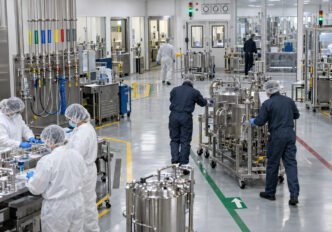
Speed can’t come at the expense of product quality. Facilities serving multiple clients may handle different formulations, chemicals, allergens, biological materials or other substances that require careful segregation. Effective contamination control therefore needs to be incorporated into the factory from the beginning.
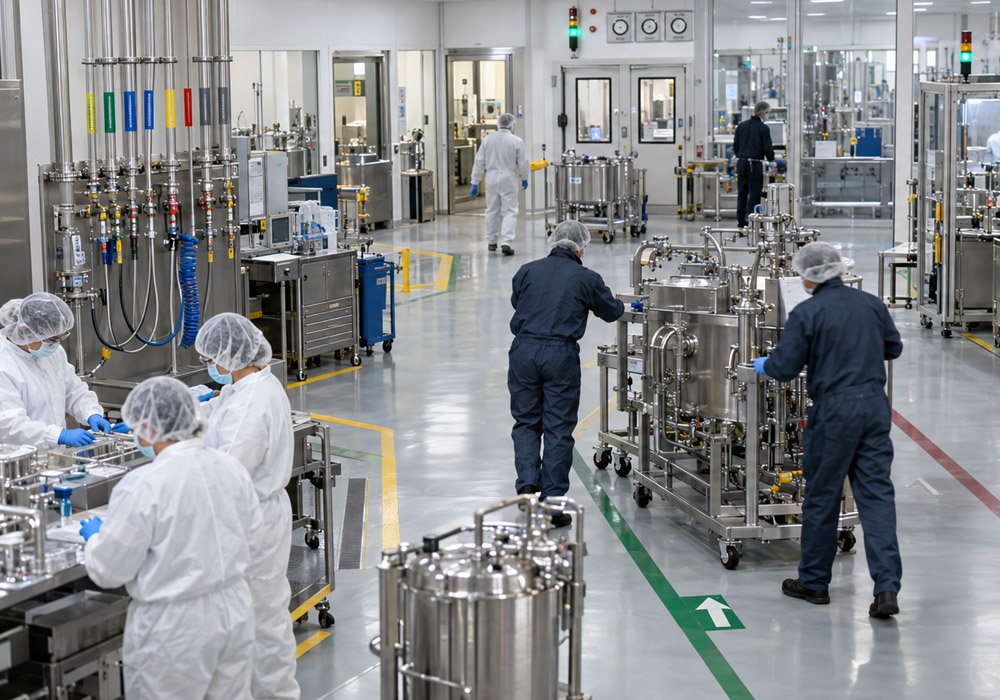
Airflow strategies, pressure differentials, controlled access, appropriate personal and material flows, hygienic surfaces and dedicated cleaning areas can all support segregation between processes. The objective is to make compliant movement straightforward. When clean and used equipment, incoming materials, waste and personnel have clearly defined routes, there are fewer opportunities for cross-contamination or procedural errors.
Use Clean Room Interlock Systems
In controlled manufacturing environments, clean room interlock systems can provide an additional layer of environmental control. Interlocked doors prevent multiple doors in a controlled transition area from opening simultaneously, helping maintain pressure differentials and limiting uncontrolled air movement between spaces.
Modern interlock systems can also be designed with installation and future modifications in mind. Systems that are easy to install and can be modified in the field using DIP switches are beneficial. They can give facilities greater flexibility when door configurations or operational requirements change. Compatibility with different door types and existing access-control systems can further simplify integration, allowing manufacturers to strengthen controlled access without extensive changes to the facility’s existing infrastructure.
This is particularly useful when people, equipment and materials must move frequently between areas with different cleanliness classifications. Interlock systems can also integrate with access controls, alarms and monitoring systems. When properly designed and validated, they help facilities maintain controlled conditions without unnecessarily slowing down movement between production areas.
Create Flexible Equipment Staging Areas
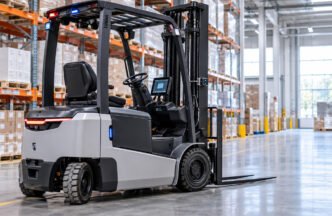
Equipment staging can have an outsized effect on changeover performance. Without dedicated staging areas, production rooms can become temporary storage spaces, creating congestion and making operators spend valuable time locating equipment and components. Optimizing warehouse layout can improve workflow efficiency, minimize bottlenecks and increase throughput.
Facilities can instead establish clearly identified zones for equipment awaiting cleaning, cleaned equipment awaiting release and equipment prepared for the next production run. Mobile racks, carts and standardized equipment footprints can make these systems even more effective.
Standardization Makes Changeovers More Predictable
Flexibility doesn’t mean creating a completely different configuration for every client. Standardization can actually make multi-client production more adaptable.
Where practical, manufacturers can standardize utility connections, equipment interfaces, room dimensions, carts, storage systems and change parts. Operators then have fewer unfamiliar tasks to perform, while maintenance teams can work with repeatable systems. Standardization also makes it easier to introduce new clients or products without requiring major physical modifications.
Design for Faster, Not Riskier, Changeovers
A 30-minute changeover should be viewed as a design objective rather than a universal benchmark. The appropriate target will depend on the manufacturing process, regulatory requirements, cleaning procedures and equipment involved.
Manufacturers should analyze where time is actually being lost. Equipment movement, cleaning, utility connections, material staging or quality release may each represent different bottlenecks.
The strongest facility designs reduce activities that must happen after production stops while moving as much preparation as possible outside the production window. This creates faster transitions without removing essential quality or compliance controls.
Turning Flexibility Into a Competitive Advantage
Faster changeovers mean more productive capacity, greater scheduling flexibility and stronger profitability. The goal is to design efficiency into every transition. With modular utilities, optimized layouts, contamination-control infrastructure, clean room interlock systems and flexible equipment staging, facilities can move between clients smoothly and consistently while maintaining rigorous quality, facility and compliance standards.