
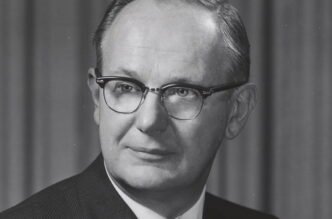

Basic Information
| Full Name | John George Trump |
|---|---|
| Date of Birth | August 21, 1907 |
| Date of Death | February 21, 1985 (age 77) |
| Primary Roles | Electrical engineer, physicist, professor at MIT, high-voltage researcher |
| Education | Advanced electrical engineering degrees (Polytechnic Institute of Brooklyn; Columbia; MIT) |
| Notable Honors | National Medal of Science (1983) |
| Key Public Service | Government consultant (WWII radar and related projects); evaluator of Nikola Tesla’s papers for federal authorities |
Overview: Who John G. Trump Was
John G. Trump was an American electrical engineer and applied physicist whose career bridged fundamental research and practical engineering at a time when radio, radar and high-voltage technologies were reshaping medicine, industry, and national security. A long-time professor at the Massachusetts Institute of Technology, Trump combined academic rigor with an ability to translate laboratory discoveries into devices and systems—most notably in high-voltage generation and in medical applications of radiation therapy.
Timeline and Key Dates
| 1907 | Born August 21 in the United States. |
|---|---|
| 1930s–1940s | Advanced study and early research in high-voltage physics and engineering; doctoral work under Robert J. Van de Graaff. |
| 1940s | Wartime contributions in radar and government research; later called upon to evaluate Nikola Tesla’s papers after Tesla’s death. |
| Postwar decades | Co-founded technical ventures, advanced medical applications (rotational radiation therapy), and led high-voltage engineering work. |
| 1983 | Awarded the National Medal of Science for his lifetime contributions. |
| 1985 | Died February 21. |
Technical Contributions and Professional Impact
John G. Trump’s work sits at the intersection of high-voltage physics, engineering design, and applied medical technology. Trained under Robert J. Van de Graaff, he helped develop compact Van de Graaff generators and other high-voltage apparatus that found applications in early radiation therapy equipment. His research and engineering leadership contributed to the maturation of rotational radiation therapy approaches and more broadly to the translation of powerful laboratory devices into reproducible clinical machines.
Beyond medicine, Trump was a trusted wartime and peacetime consultant for technologies of strategic importance—radar research during World War II and high-voltage engineering afterward. He co-founded the High Voltage Engineering Corporation and other technical ventures, establishing pathways for industry to adopt rigorous research outcomes.
Public Service: The Tesla Papers Review
Shortly after Nikola Tesla’s death, federal authorities tasked John G. Trump to examine Tesla’s papers for any potential national-security concerns. His evaluation—conducted with professional caution and technical thoroughness—concluded that the materials did not contain pragmatic, weaponizable “death-ray” devices. That assessment, cited in historical treatments of both Tesla and mid-century intelligence practice, demonstrates how Trump’s credibility led government agencies to rely on his technical judgment in sensitive matters; for an accessible contemporary account see the PBS discussion of the Tesla archives.
Further reading on this episode is available through PBS’s Tesla materials and institutional summaries of his government work.
Authoritative institutional recognition followed a career of disciplined technical achievement: in 1983 Trump received the National Medal of Science—one of the nation’s highest honors for scientific contribution—underscoring the long-term value of his research and leadership in high-voltage applications and medical physics.
Legacy, Influence, and How He Is Remembered
John G. Trump’s legacy is twofold. Within engineering and medical-physics communities he is remembered for concrete advances in instrumentation and for shepherding laboratory physics into useful clinical and industrial tools. Outside technical circles, he is occasionally referenced in cultural and family histories—but his professional reputation stands on awards, institutional affiliations, and a track record of pragmatic invention.
Contemporary institutional pages and retrospectives (including entries summarizing his National Medal and MIT career) are the best available windows into his lasting impact; for a concise institutional profile consult the National Medal of Science laureate page.
Selected Publications, Ventures and Institutional Roles
| Area | Contribution |
|---|---|
| High-voltage generators | Design and refinement of compact Van de Graaff and related systems for research and medical use |
| Medical physics | Applied rotational radiation therapy concepts and supported translation to clinical devices |
| Industry | Co-founded High Voltage Engineering Corporation to move research into practice |
| Government consulting | Wartime radar work and postwar technical evaluations, including review of Tesla papers |
Further Reading and Primary Sources
For readers who want to dig deeper, the following sources provide institutionally vetted summaries and contemporary reporting: John G. Trump’s encyclopedic profile on Wikipedia, the PBS overview of the Tesla papers and their handling, and the National Medal of Science laureate profile document his recognized contributions. Cultural and biographical perspectives occasionally surface in profiles such as the New Yorker piece that situates his life within a broader family history.
Biographical and genealogical contexts—relevant for those researching familial antecedents—are available through broader family-history references; see the dedicated page about Susanna Maria Bechtloff for an example of how earlier generations are documented in public genealogy records.
FAQ
When was John G. Trump born and when did he die?
John G. Trump was born on August 21, 1907, and he died on February 21, 1985, at the age of 77.
What fields did John G. Trump work in?
He worked primarily in electrical engineering and applied physics, with significant contributions to high-voltage engineering and medical radiation technology.
Why was John G. Trump asked to review Nikola Tesla’s papers?
Federal authorities turned to him because of his recognized expertise in high-voltage physics and because he was a trusted, technically rigorous consultant for government science matters.
What major awards did John G. Trump receive?
Among his highest honors, he was awarded the National Medal of Science in 1983 for his lifetime contributions to engineering and applied physics.
Where can I learn more about his technical work?
Authoritative summaries can be found on his Wikipedia page, the National Medal of Science laureate profile, and historical treatment of the Tesla papers on PBS, which outline the technical and historical context of his work.